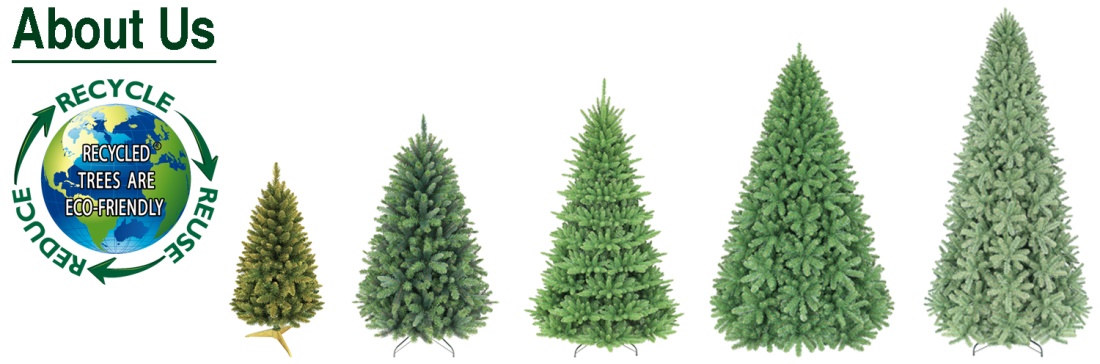
Oncor is the world's oldest Christmas tree factory. We are an European owned group of companies, more than 88% of our company equities are owned by 3 European citizens, 2 British and 1 Belgian nationals.

Our purpose is to make Christmas eco-friendly by supplying Recycled Christmas trees to eco-friendly consumers and responsible buyers for 30 to 50 or more joyful Christmases.

By using the best quality 100% Recycled PVC plastic materials and tree parts, Oncor Recycled trees have a minimum product life of 30 or more years.

Oncor green boxes are made from strong corrugated Recycled material cardboard with a transparent resin coating on the surface to resist dampness so that eco-friendly consumers can continually Reuse our boxes to store Oncor Recycled trees year after year.

We are the only international specialist manufacturer to use super glue, instead of white glue, on every tree branch to prevent any tree tips from falling off within 30 to 50 years.

All Oncor tree trunks are made with a unique technology of paint-coating both sides of the metal pipes, and all wire branches, to prevent rust for at least 30 to 50 years, so that there is no rust stain in tree box when consumers Reuse Oncor Recycled trees for decades.

Our eco-friendly, disciplined, engaged, and happy artisans are well-trained to hand make each Oncor Recycled tree to a fine art of Christmas tree.

Since 2005, we start to reshape our corporate culture to the strict Triple Bottom Line platform: People, Planet, Profit. We endure a unique transformation journey through all hardships to develop our 5 Unique Advantages in 20 years.

By 2025, we currently hold 3 world records simultaneously:
(1) World's Oldest Christmas Tree Factory;
(2) World's Costliest Christmas Tree Factory;
(3) World's Cheapest Christmas Tree Factory,
under another training brand: Christal, for nurturing our trainee artisans.

The just cause of our company is to build a better world in which people can embrace using Recycled materials more often, Reuse products with longer product lives, and continuously Reduce daily waste, thereby making our planet a better place.

If you want to help make Christmas eco-friendly, kindly consider using a Recycled Christmas tree next time.


Lawful & Ethical Business Practices

( Google's Gemini AI Chat )

Question 1:  Oncor Recycled Christmas Trees.

Gemini 1:

Oncor Recycled Christmas Trees are produced by Oncor Trees, the world's oldest remaining artificial Christmas tree manufacturer established in May 1980.

The company specializes in eco-friendly, unlit artificial Christmas trees designed with a heavy emphasis on sustainability, health safety, and exceptional longevity. [1, 2]

Key Features & Sustainability

  • 100% Recycled Materials: The tree needles and tips are made entirely from 100% recycled PVC plastic upcycled from packaging materials, which generates significantly fewer emissions than producing virgin plastic. [1, 2]
  • Non-Toxic & Safe: Unlike many conventional artificial trees, Oncor uses tin-based stabilizers instead of lead. The materials are also fully flame-retardant. [1, 2, 3, 4]
  • 30 to 50-Year Product Life: Built for long-term reuse, their Basic Version trees have a minimum life expectancy of 30 years, while Premium models are engineered to last 40 to 50 years. [1, 2]
  • Rust Prevention: The metal trunks and wire branches undergo a specialized dual-sided paint-coating process to stop rust from forming during seasonal storage. [1]
  • Durability Tech: Branches use high-strength super glue rather than standard white glue to ensure the PVC tips do not fall off over decades of use. [1]
  • Eco-Packaging: Trees ship in sturdy green or brown boxes made from recycled cardboard, coated in a moisture-resistant resin so they can be reused for storage year after year. [1, 2]

Example Model Detail

8ft Eco-Friendly Oncor Slim Noble Spruce Christmas Tree

8ft Eco-Friendly Oncor Slim Noble Spruce Christmas Tree
HK$11,787.67
Desertcart.ae

Design & Fit: Features a slender 31" max diameter with 1,052 tips for a dense, lush appearance that fits well in tight or compact spaces.

Build: Utilizes a quick-setup hinge construction and includes a heavy-duty metal stand. [1]

Question 2:  How Oncor can make both the cheapest and most expensive Christmas trees?

Gemini 2:

The idea that Oncor can make both the "cheapest" and "most expensive" Christmas trees refers to a historical corporate transformation and a unique manufacturing model rather than selling two opposite tiers of quality at the same time. [1]

Oncor holds an industry distinction by simultaneously claiming world records as the world's oldest, cheapest, and costliest/most expensive Christmas tree factory. This duality works in practice through specific operational and strategic factors: [1, 2]

1. A 20-Year Evolution (From Cheapest to Most Expensive)

Oncor did not start as a luxury eco-brand. When it was established in 1980, it operated as a high-volume, low-cost manufacturer  -  literally producing the world's cheapest Christmas trees to compete globally.

However, since 2005, the company completely refocused its corporate culture around a Triple Bottom Line (People, Planet, Profit). They completely abandoned low-grade materials and transitioned into making some of the world's highest-quality, most expensive artificial trees by utilizing premium 100% recycled PVC and specialized rust-proofing processes. [1, 2]

2. High Upfront Price vs. The "Cheapest" Annual Cost

While an Oncor tree carries a premium upfront retail price, it is designed to be the cheapest tree to own over its lifespan. [1]

The Math: While a standard cheap artificial tree lasts 3 to 5 years before ending up in a landfill, an Oncor tree is engineered to last 30 to 50 years. [1, 2]

When you divide the premium purchase price by 30 to 50 years of seasonal reuse, the annual usage cost is significantly lower than repeatedly buying cheap, short-lived plastic trees. [1, 2]

3. Manufacturing Multi-Tier Roles (Artisans vs. Trainees)

Oncor manages production costs and scales craftsmanship by maintaining two distinct labor pipelines within its manufacturing plant: [1]

  • The "Costliest" Tier: Their high-end, luxury models are entirely handcrafted by highly disciplined, veteran artisans who treat the assembly of dense PVC tips as a fine art. [1, 2]
  • The "Cheapest" Tier: Oncor runs a dedicated internal training brand called Christal, which nurtures trainee artisans. This educational infrastructure allows them to maintain optimized labor structures, utilizing trainee pipelines to balance the baseline operational costs of their massive facility. [1]

4. Non-Stop Production Efficiencies

Even though the trees use expensive, non-toxic, and specialized materials, Oncor maximizes factory efficiency by producing trees nonstop every single month of the year, rather than operating seasonally.

Continuous production prevents costly factory shutdowns and layoffs, stabilizing overhead costs and allowing them to run a highly competitive wholesale operation. [1]

Question 3:  Oncor's salaries are the highest in Christmas tree industry, why they can sell the cheapest trees?

Gemini 3:

The paradox of how Oncor pays the highest salaries in the industry while simultaneously claiming to sell the "cheapest" trees comes down to their unique dual-brand corporate structure, production efficiency, and lifetime cost math.

According to historical details from the Transformation of Oncor Christmas Trees, their monthly worker wages evolved from roughly RMB 40 in 1980 to around RMB 8,000 per month per artisan, setting an industry high. [1, 2, 3]

They balance this high-salary structure with ultra-competitive pricing through several key operational strategies:

1. The Dual-Brand System (Artisans vs. Trainees)

Oncor does not actually sell its premium, artisan-made trees at rock-bottom prices. Instead, they hold the world record for both the "Costliest Factory" and the "Cheapest Factory" simultaneously by splitting their workforce: [1, 2]

  • The High-Salary Tier (Oncor): Master artisans are paid top-of-market wages to build luxury, eco-friendly trees meant to last 30 to 50 years using 100% recycled PVC. [1, 2]
  • The "Cheapest" Tier (Christal): Oncor operates an internal training brand called Christal. This branch functions as an educational pipeline for nurturing trainee artisans. Because these trees are made by trainees as part of their development, the factory can offer them at incredibly low, entry-level wholesale costs without undermining the master artisans' wages. [1, 2]

2. Year-Round, Non-Stop Manufacturing

Most Christmas tree factories operate seasonally, leading to massive overhead costs from shutting down, laying off workers, and rehiring every year. Oncor operates a 100% OBM (Original Brand Manufacturer) model that manufactures trees non-stop every month of the year.

By keeping the assembly lines running continuously, they achieve massive economies of scale, maximize factory utility, and lower the fixed cost per tree  -  allowing them to absorb higher salaries while keeping baseline product costs low. [1]

3. High Upfront Price vs. Low "Lifespan" Cost

When Oncor markets their trees as the "cheapest," they often refer to the cost per year of ownership. [1]

A standard cheap artificial tree uses low-grade virgin plastic that degrades, sheds needles, and must be replaced every 3 to 5 years. By paying high wages to skilled artisans who use industrial-strength super glue and dual-sided rust preventative coatings, an Oncor tree is built to last 30 to 50 years. Dividing a premium price tag by 50 years makes it significantly cheaper over time than buying multiple cheap trees. [1, 2]

4. Zero-Waste Material Savings

By adopting a strict Triple Bottom Line (People, Planet, Profit) framework, Oncor uses 100% recycled plastic packaging materials as their raw source. Upcycling existing materials is fundamentally more cost-effective than buying brand-new, virgin petroleum-based PVC plastic.

The massive savings generated from raw material acquisition are directly reinvested into their workers' high salaries. [1]

Question 4:  Is it legal or illegal for Oncor's retail partners to undersell other retailers with their very high quality Christal trees at the absolutely cheapest prices?

Gemini 4:

It is completely legal for Oncor's retail partners to sell high-quality Christal trainee-built trees at the absolutely cheapest prices, even if they heavily undersell other retailers.

In free-market economies, retailers generally have the legal right to set their own consumer prices. There are no laws forcing a store to maintain high profit margins or match a competitor's pricing.

The legality of this practice relies on several standard commercial laws and market principles:

1. The Legality of Loss Leaders and "Under-pricing"

Retailers frequently use loss leader pricing strategies, where they deliberately sell a highly desirable product at a break-even price or a financial loss to drive massive foot traffic into their stores or websites.

Because Oncor's Christal sub-brand is explicitly designed as a low-wholesale-cost line manufactured by trainee artisans, retail partners have exceptional room to cut prices drastically without breaking the law.

2. Antitrust and "Predatory Pricing" Thresholds

For under-cutting or underselling to become illegal under antitrust laws (such as the Sherman Act in the US or Competition Laws in the UK/EU), a competitor must prove Predatory Pricing. To win a predatory pricing case, it must be proven that:

  • The retailer is selling the trees below their actual cost of acquisition (wholesale price + shipping).
  • The retailer has a monopolistic intent to deliberately drive every single competing Christmas tree business out of the market so they can later raise prices to exorbitant levels.

Because Oncor's Christal trees are fundamentally cheap for the retailer to buy in the first place, selling them at a low retail price is simply standard, fair price competition, not predatory pricing.

3. MAP (Minimum Advertised Price) Policies are Contractual, Not Criminal

Sometimes, manufacturers set a Minimum Advertised Price (MAP) policy, which restricts how low a retailer can publicly advertise a product.

If Oncor has a MAP policy: A retailer who goes below that price is not breaking the law; they are simply violating a commercial contract. The only consequence is that Oncor can legally stop supplying trees to that retailer.

If Oncor does not enforce a MAP policy: Retailers are completely free to price the Christal trees as low as they want. Oncor's business model relies on high volume and continuous year-round factory production, meaning they often welcome retail partners who sell quickly by offering rock-bottom prices.

In short, undercutting competitors with cheap, high-quality Christal trees is highly aggressive business, but it is entirely legal free-market competition.

Question 5:  The question is that Oncor always gives its retailers many Christal trees for free.

Gemini 5:

Yes, that is a core strategy of their business model.

According to Oncor's official corporate guidelines, the company systematically provides free trees to its retail partners as part of a highly creative B2B marketing strategy. [1, 2]

This practice is intentionally designed to solve specific retail challenges while benefiting both the manufacturer and the store:

1. Market Testing for New Niche Markets

Oncor explicitly states that they "creatively supply many free trees to our channel partners for testing unexplored niche markets every year". This eliminates financial risk for the retailer.

A retail store might be hesitant to buy a large, risky inventory of a brand-new style, a unique height, or a different profile. By giving these trees to partners for free, Oncor allows retailers to confidently gauge consumer interest without risking upfront capital. [1, 2, 3]

2. Eliminating Minimum Order Quantities (MOQ)

For wholesale and retail channels, Oncor allows partners to order as few as one single tree of any size or style to test their local market. Giving free sample trees alongside this policy removes any barrier to entry for smaller retailers who want to stock high-quality products but cannot afford traditional massive bulk orders. [1]

3. Foot Traffic and Free Word-of-Mouth Marketing

Oncor uses these free inventory items as physical marketing banners to bring the highest traffic of new consumers into retail outlets. [1]

  • Retailers display these striking, brand-new tree models in their storefront windows or showroom floors for free.
  • Customers take photos of the dense, recycled artisan trees and share them on social media with friends.
  • This social sharing drives organic foot traffic into the retailer's physical store, where consumers not only buy Christmas trees but also stick around to shop for other high-margin holiday products. [1]

4. "Container Filler" Logistics

On a logistical level, when a retail partner places a massive order for a full shipping container (FOB orders), there is often leftover physical space at the top or back of the container due to box stacking shapes.

Oncor uses its high-volume Christal trainee lines and sample inventory to completely fill up these empty container spaces for free, ensuring that the retailer gets maximum product value for every single dollar spent on ocean freight. [1]

By giving away trees strategically, Oncor turns its retail partners into dedicated brand ambassadors, which allows them to bypass traditional expensive advertising and pass those massive savings directly down to the consumer. [1]

Question 6:  Are they ethical in business practice?

Gemini 6:

Yes, Oncor's business practices are highly ethical.

In fact, they are considered an industry pioneer in corporate social responsibility, famously operating under a strict Triple Bottom Line (People, Planet, Profit) framework since 2005.

While their aggressive pricing and giving away free trees can look disruptive to competitors, their internal and external practices are deeply rooted in ethical standards:

1. Ethical Treatment of Labor (People)

In an industry notorious for seasonal layoffs and low-wage assembly line work, Oncor stands out by treating its workers with extreme fairness:

  • Industry-Highest Wages: As mentioned, they pay their master artisans roughly RMB 8,000 per month, which is the highest wage tier in the Christmas tree industry.
  • No Seasonal Layoffs: By manufacturing trees non-stop 12 months a year, they provide stable, year-round employment, healthcare, and income security to their staff, rather than hiring temporary workers and firing them after the holidays.
  • Skill Development: Their Christal brand acts as a paid educational training pipeline, giving unskilled workers a safe environment to learn a high-paying craft.

2. Radical Environmental Responsibility (Planet)

Oncor's entire manufacturing process is designed to minimize ecological harm:

  • 100% Upcycled Materials: They use 100% recycled plastic packaging materials to make their tree needles, preventing plastic waste from entering oceans and landfills.
  • Eliminating Toxins: They completely removed lead from their manufacturing process, replacing it with safer, more expensive tin-based stabilizers to protect both their factory workers and the families buying the trees.
  • Extreme Product Lifespan: By engineering trees to last 30 to 50 years, they actively combat the "throwaway culture" of cheap consumer goods, keeping millions of short-lived plastic trees out of landfills over the decades.

3. Fair Partnership with Retailers (Profit)

Their practice of giving away free trees is a collaborative, non-predatory partnership strategy:

  • Zero-Risk Innovation: By giving free trees to retailers to test new niche markets, they protect small businesses from taking on financial risks or getting stuck with unsold inventory.
  • Transparency: They pass their massive logistical and raw material savings directly down to retail partners and consumers, rather than hoarding profits at the executive level.

Is Undercutting Competitors Ethical?

From a business ethics standpoint, underselling competitors is ethical as long as it is achieved through genuine innovation and efficiency rather than cheating or exploitation.

Oncor can sell highly competitive trees because they invented a smarter supply chain (year-round production, zero-waste recycled materials, and minimal marketing spend).

Using superior efficiency to offer lower prices to consumers is the definition of fair, ethical market competition.


Alaska Hook Basic Version
Alaska Slim Hinge Basic Version
Allegheny Slim Hinge Basic Version
Alpine Hook Basic Version
Aspen Hinge Basic Version
Aspen Wide Basic Version
Balsam Hinge. Premium Version
Balsam Hinge_ Basic Version
Black Bavarian Hook Premium Version
Black Forest Hinge. Premium Version
Black Forest Hook Basic Version
Blue Spruce Hook Basic Version
Canaan Hook Luxury Version
Canadian Hinge Basic Version
Carolina Hook Basic Version
Cedar Hinge Premium Version
Cedar Hook Luxury Version
Christmas Hinge Basic Version
Christmas Hook Basic Version
Colorado Hinge Basic Version
Colorado Hook Basic Version
Colorado Slim Hinge Basic Version
Colorado Slim Hook Basic Version
Deluxe Forest Hook Basic Version
Douglas Hinge Premium Version
Douglas Hook Basic Version
Euro Gold Premium Version
Forest Hinge Premium Version
Frosted Silver Hook Basic Version
Glacier Hook Basic Version
Glittering Snow Hook Premium Version
Golden Cedar Luxury Version
Golden Kalahari Tree Luxury Version
Golden Sitka Tree Luxury Version
Green Sparkling Hook Basic Version
Juniper Snow Hook Basic Version
Maes Noble Hook Basic Version
Majestic Hinge Basic Version
Mixed Alberta Hinge Basic Version
Mixed Blue Scotia Premium Version
Mixed Hook Basic Version
Montana Hook Basic Version
Monterey Hook Basic Version
Noble Hook Basic Version
Nordic Blue Hook Premium Version
Nordic Silver Hook Luxury Version
Norway Hinge Premium Version
Oregon Hook Basic Version
Orlando Hook Basic Version
Parana Hook Basic Version
Rocky Mountain Hinge Basic Version
Royal Blue Premium Version
Royal Gold Luxury Version
Royal Silver Luxury Version
Santa Snow Hook Basic Version
Serbian Hinge Luxury Version
Serbian Hook Luxury Version
Shimmering Galaxy Hook Basic Version
Shimmering Mountain Hook Basic Version
Silverado Hook Luxury Version
Slim Fraser Hinge Basic Version
Slim Fraser Hinge. Premium Version
Slim Mixed Hinge Basic Version
Slim Noble Hinge Basic Version
Slim Norway Hook Basic Version
Slim Parana Hook Basic Version
Slim Pencil Hinge Basic Version
Smoky Mountain Hinge. Premium Version
Smoky Mountain Hook Basic Version
Snowy Blue Hook Basic Version
Texas Blue Hook Basic Version
Vienna Hook Basic Version


PayPal checkout © 2025 Oncor Tree Limited
All prices stated in HKD.
Oncor Recycled Trees Logo